End-of-Life Pavement Strategies: Milling, Rubblization & Material Circularity Roadmaps
Why End-of-Life Strategy Matters
When an asphalt or concrete pavement reaches the end of its service life, owners face a pivotal choice: remove and replace the structure in its entirety or harvest maximum value from the existing layers. The latter approach, designing an end-of-life (EOL) strategy, can:
-
Cut lifecycle costs by 20 – 40 % compared with full reconstruction.
-
Reduce construction‐related greenhouse-gas (GHG) emissions and trucking miles for virgin aggregates.
-
Speed reopening of critical roadways, minimizing user delay costs and political friction.
-
Advance circular-economy goals already embedded in many state DOT sustainability plans.
This article explores three complementary EOL tactics, milling, rubblization, and material-circularity road-mapping, and shows how to weave them into a decision tree that highway agencies can defend financially, environmentally, and publicly.
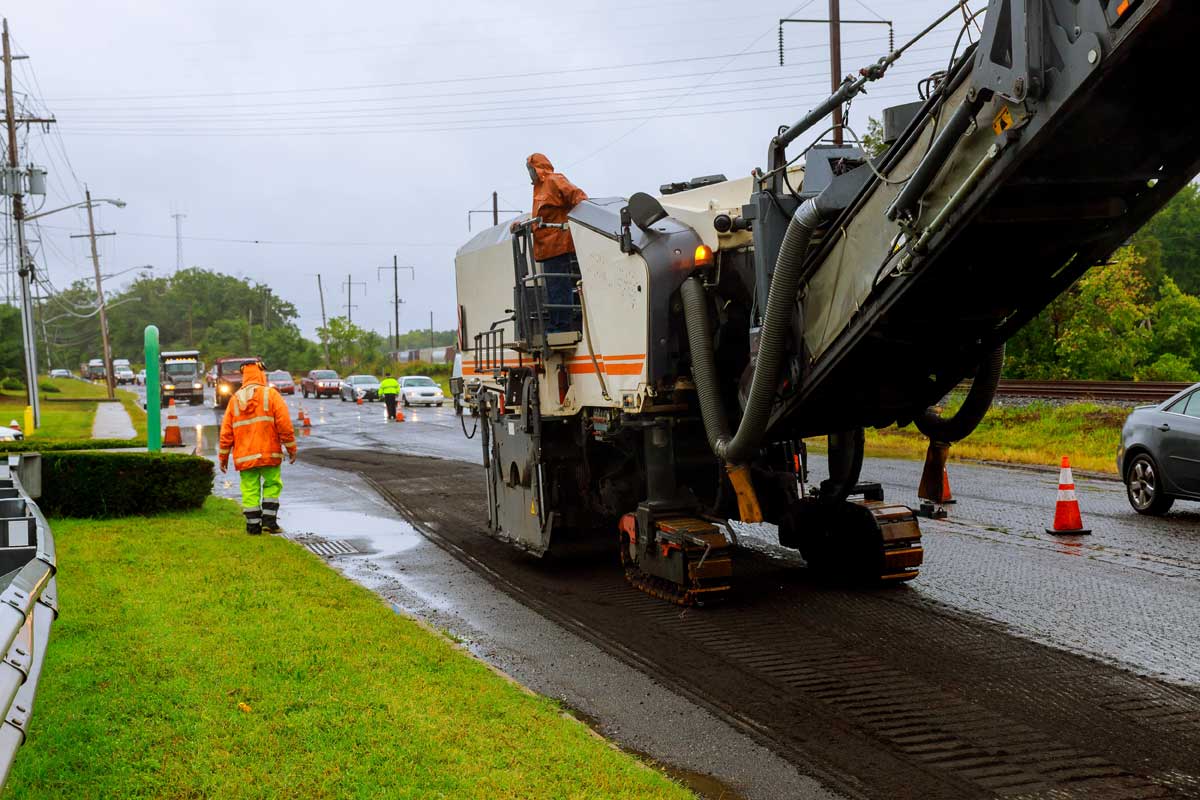
Cold Milling (Cold Planing)
| Attribute | Key Points |
|---|---|
| Purpose | Remove a controlled thickness (3 mm – 125 mm+) of asphalt to restore profile, correct cross-slope, eliminate surface distress, or prepare for an in-place overlay. |
| Equipment | Half-lane or full-lane cold planers (up to 4 m drum width) with computerized grade-control and automated water injection for dust suppression. |
| Output Material | Reclaimed Asphalt Pavement (RAP) with 95 % passing the 19 mm sieve and low moisture if trucked covered. |
| Typical Yields | 200–300 t/hour (urban) and 400 t/hour+ (rural mainline). |
| End Uses | Hot-mix asphalt (HMA) with 20–40 % RAP content, cold in-place recycling (CIR) stock, or stabilized shoulders. |
Best-Practice Tips
-
Adjust depth dynamically via 3-D scanning sensors to avoid excess cuts into structurally sound layers.
-
Isolate special mixes (OGFC, stone matrix asphalt) in separate trucks for high-value recycling.
-
Specify RAP fractionation at the asphalt plant if high binder performance is required (e.g., PG 64-22 results).
-
Track milling energy use and truck haul distances for Scope 3 GHG accounting.
Rubblization
Rubblization breaks a deteriorated concrete pavement into small, well-graded particles that act as a high-modulus aggregate base. A thin HMA or concrete overlay then carries future traffic loads.
| Attribute | Key Points |
|---|---|
| Target Pavements | CRCP or JPCP with severe transverse cracking, punch-outs, or faulting but adequate subgrade support. |
| Equipment | Resonant pavement breaker or multi-head breaker, followed by high-frequency vibratory roller and pneumatic tire roller. |
| Fragment Size | 75–150 mm at the surface grading to 25–50 mm near mid-depth. |
| Overlay Options | 125 mm+ HMA or 200 mm+ bonded concrete overlay. |
| Structural Coefficient | Up to 0.22 (AASHTO 1993) compared with 0.14 for untreated aggregate bases. |
3.1 Operational Considerations
-
Pre-project Falling Weight Deflectometer (FWD) tests ensure subgrade strain is acceptable after breakup.
-
Edge drain retrofits are recommended if hydraulic conductivity is low.
-
Rubblize-first logic often delivered savings of USD 200k – 400k per mile on Interstate rehabilitations, with 20-year performance equal to reconstruction.
Material Circularity Roadmaps
Define Circularity Metrics
| Metric | Definition | Tool/Source |
|---|---|---|
| RAP/RCA Utilization Rate | % of total binder/aggregate demand met with recovered material. | Mix-design submittals, plant batch tickets |
| Closed-Loop Recycling Index | Share of RAP/RCA reused in equal or higher-grade applications. | Life-cycle inventory (LCI) databases |
| Embodied Carbon Intensity (ECI) | kg CO₂e per lane-km, cradle-to-gate. | FHWA’s LCCA & Pavement LCA tools |
| Recyclate Displacement Factor | Tons of virgin aggregate saved per ton of recycled material. | Contract quantity tracking |
Four-Step Roadmap Framework
-
Inventory existing and projected waste streams (milled asphalt, rubblized concrete, shoulder materials).
-
Match outputs to in-house or regional markets: HMA plants, soil-cement bases, geopolymer concrete, etc.
-
Standardize recycled material specs (gradation envelopes, binder availability, contaminant thresholds).
-
Measure & Publish annual circularity scorecards to align with ESG reporting and grant requirements.
Example Targets (10-Year Horizon)
| Year | RAP in HMA (%) | RCA in Base (%) | ECI Reduction vs. 2025 Baseline |
|---|---|---|---|
| 2027 | 25 | 15 | 10 % |
| 2030 | 35 | 25 | 20 % |
| 2035 | 45 | 35 | 35 % |
Putting It All Together: A Decision Tree
Trigger: PCI < 40 OR IRI > 3 m/km
    ├─ Structural Capacity Adequate?
    │     ├─ Yes → Cold Mill 40–60 mm → Overlay (RAP-rich HMA) → Monitor
    │     └─ No
    │           ├─ Existing Pavement Concrete?
    │           │     ├─ Yes → Rubblize → HMA/BCO Overlay → Edge Drains → Monitor
    │           │     └─ No → Full-Depth Reclamation (FDR) → New Surface
    │           └─ Subgrade Weak → Stabilize Subgrade → Proceed as above
Key Gate Checks
-
FWD deflections < 450 µm post-rubblization.
-
Overlay thickness meets 20-year ESAL projections plus local climate adjustment.
-
Circularity KPI compliance (minimum 25 % RAP or 15 % RCA) baked into bid schedule.
Implementation Case Snapshots
| Project | Treatment | Savings vs. Reconstruction | Circularity Outcome |
|---|---|---|---|
| I-94, Wisconsin (2023) | 34 km rubblize + 150 mm HMA | USD 6 M (≈ 28 %) | 94 kt concrete kept on-site; 30 % RAP overlay |
| SR-22, Ohio (2024) | Mill 50 mm + OGFC overlay | USD 1.2 M (≈ 18 %) | 25 % RAP in surface mix; 100 % fines reused in shoulder berm |
| SH-199, Texas (2025) | Mill & In-Place Cold Recycle 100 mm | USD 4 M (≈ 22 %) | 100 % RAP reuse; net-zero aggregate import |
Best-Practice Checklist
| Domain | Checklist Item |
|---|---|
| Design | Run mechanistic-empirical (M-E) software for each EOL scenario. |
| Materials | Fractionate RAP; perform blend charts to optimize binder grade bumping. |
| Construction | Use automated machine guidance (AMG) on milling drums and pavers. |
| QA/QC | Adopt intelligent compaction (IC) and infrared thermography on overlays. |
| Finance | Include social cost of carbon (SCC) in LCCA to capture rubblization benefits. |
| Governance | Publish annual “Pavement Circularity Report” for public transparency. |
End-of-life pavement strategies are no longer “back-of-the-napkin” exercises performed under budget duress. With robust data on milling, rubblization, and material circularity, agencies can craft roadmaps that stretch every tax dollar, slash embodied carbon, and showcase environmental stewardship to stakeholders. By embracing a formal decision tree and tracking circular-economy KPIs, highway departments transform what was once waste into the feedstock of next-generation infrastructure.


Life-Cycle Assessment of Pavement Alternatives: Quantifying Environmental Impacts from Cradle to Grave

When Is the Best Time of Year to Sealcoat?

Poor Subgrade Support: Detecting and Fixing the Root of Premature Rutting

Developing a Pavement Rehabilitation Plan Based on PCI Data

Joint Resealing & Spall Repair for Concrete Roads
