Articles Tagged: pavement preservation
Pavement design isn’t just about strength, smoothness, and cost anymore. It’s also about sustainability-how each material and process affects the environment across its entire lifespan. That’s where Life-Cycle Assessment (LCA) comes in. This analytical approach measures the total e…
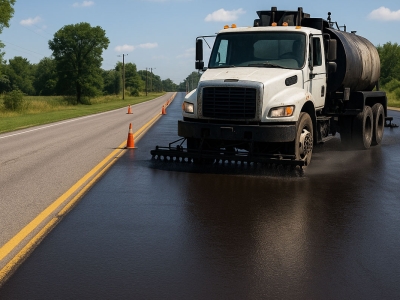
Sealcoating is one of the simplest and most cost-effective ways to protect your asphalt pavement, but timing is everything. Apply it too early in the season and cold temperatures can prevent the material from curing properly. Wait too late, and cool nights or early frost can ruin a perfectly good jo…
Why Subgrade Strength Matters The subgrade is the ultimate load-bearing layer of every pavement system. If it lacks adequate stiffness or uniformity, vertical wheel loads are amplified downward, causing plastic deformation that migrates back to the surface as ruts. FHWA research shows that rutting i…
Why Build a Plan Around PCI? The Pavement Condition Index (PCI) converts field observations of surface distress into a single 0-100 score. Using a standardized metric lets agencies: Objectively compare pavement segments across the entire network. Quantify long-term needs and justify funding. Trigger…
Keeping Pavement Joints Tight and Surfaces Sound Why Joint Resealing and Spall Repair Matter Concrete pavements depend on tight, watertight joints and sound slab edges to deliver long service life. When sealants fail or joint faces spall, water and incompressibles infiltrate the slab support system,…
A pavement is only as good as the ground it rests on. Accurately characterizing subgrade strength and stiffness is therefore one of the most consequential steps in pavement design. From rapid field tools like the Dynamic Cone Penetrometer (DCP) to sophisticated laboratory measurement of resilient mo…
Comparing Pervious Concrete, Porous Asphalt, and Interlocking Concrete Pavers (PICP) Why Permeable Pavements Matter Conventional pavements shed rainfall almost instantly, sending large volumes of runoff, and its pollutants, into pipes, channels, and ultimately receiving waters. Permeable (a.k.a. per…
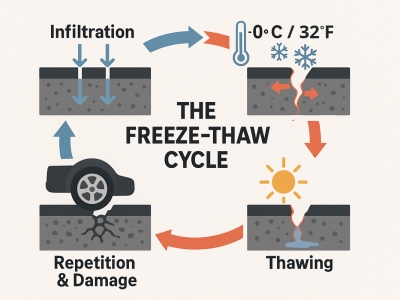
In cold-climate regions, a single kilometre of asphalt pavement can experience 50-100 freeze-thaw events every winter. Each event may seem insignificant, but together they account for billions of dollars in pavement‐related repair costs, traffic delays, and vehicle damage every year. Understanding t…
Picking the Right Rebuild Strategy for Worn-Out Pavements Why These Two Methods Dominate Heavy-Rebuild Work When pavement distress goes beyond what crack sealing, patching, or mill-and-overlay can handle, agencies usually narrow the field to two heavyweight contenders: Approach Core Idea Typical Dep…
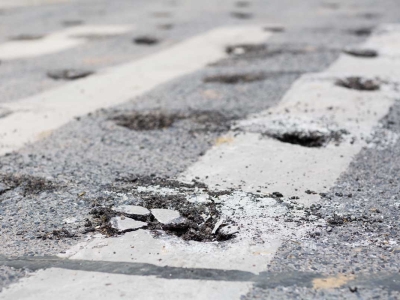
Spring thaw is when potholes, and frustrated phone calls, multiply. But it’s also the time crews are forced to patch with less-than-ideal weather, limited hot-mix availability, and saturated pavement. The result is all too familiar: a “fixed” hole pops back open weeks, or even days…
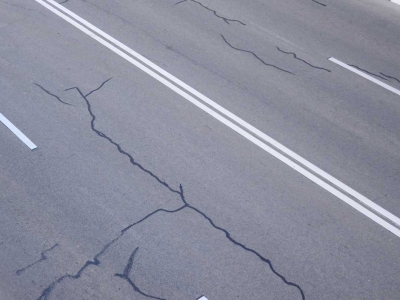
Small cracks rarely stay small. Moisture and traffic turn a hairline fissure into potholes, base failures, and, eventually, a full-depth reconstruction bill. Two frontline countermeasures keep that progression in check: crack sealing and crack filling. They share the same goal, keep water and incomp…
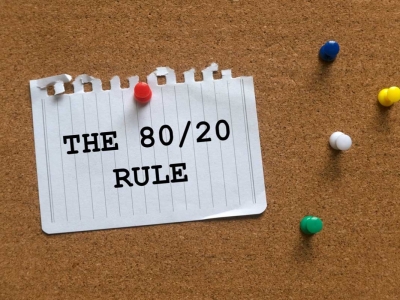
(Why targeting the “vital few” miles, and dollars, pays off) What the 80/20 Rule Is The 80/20 Rule, or Pareto Principle, states that roughly 20 percent of inputs generate about 80 percent of results (investopedia.com). Though the split is seldom exactly 80/20, it’s a useful lens fo…